Perturbators
All components which take an input example and return a transformed version of it are called perturbators in InSynth.
InSynth provides a set of abstract base classes as well as a set of concrete implementations of perturbators. The
common base class all perturbators derive from provides an empty skeleton for concrete implementations to use.
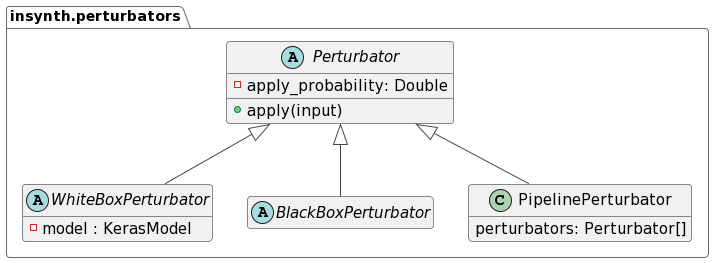
Additionally, the WhiteBoxPerturbator, BlackBoxPerturbator and PipelinePerturbator classes are provided.
The
WhiteBoxPerturbatorclass is the base class for perturbators which use knowledge about the models’ internal structure during input generation.The
BlackBoxPerturbatorclass is the base class for perturbators which can generate inputs without any external information.The
PipelinePerturbatorclass is a concrete perturbator implementation which can be used to chain a list of existing perturbators. It is provided as it can conveniently be included in an existing testing workflow.
InSynth also provides a set of blackbox, domain-specific perturbator implementations for the image, audio and text domains.
All perturbators provided by InSynth whose perturbation strength can be adjusted take a probability distribution as input. During input generation, the perturbator samples from this distribution to determine the perturbation strength.
For more details on the image domain perturbators, see the Image Perturbators section.
For more details on the audio domain perturbators, see the Audio Perturbators section.
For more details on the text domain perturbators, see the Text Perturbators section.
Pipeline Perturbator
The PipelinePerturbator class is a concrete perturbator implementation which can be used to chain a list of existing
perturbators. It can easily be integrated into an existing testing workflow to apply combinations of perturbators.
Usage
from insynth.perturbators.pipeline import PipelinePerturbator
from insynth.perturbators.image import ImageNoisePerturbator,ImagePixelizePerturbator
from PIL import Image

pert =  PipelinePerturbator([ImageNoisePerturbator(p=1.0), ImagePixelizePerturbator(p=1.0)])
image = Image.open('path/to/image.jpg')
mutated_image = pert.apply(image)